


You’re cooking dinner and you notice the knife in your hand. Or you’re holding your baby. Or you’re driving next to a cyclist. And suddenly your mind asks: what if I did something terrible?
You don’t want to. You’d never want to. But the thought won’t leave.
If you ever feel you might act on suicidal thoughts or are in crisis, contact the 988 Suicide and Crisis Lifeline by calling or texting 988 (U.S. only). If you’re outside the U.S., you can find international hotlines here or visit your nearest emergency department.
What is Harm OCD?
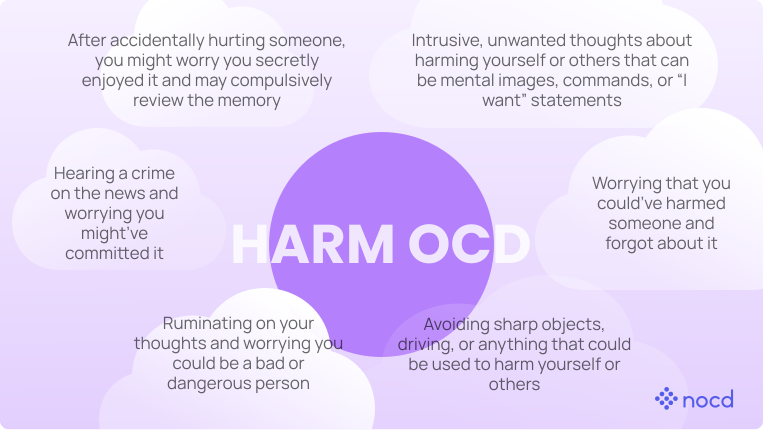
Harm OCD is a subtype of obsessive-compulsive disorder (OCD) that involves intrusive, repetitive thoughts, images, urges, feelings, or sensations about violence, accidents, or injury. These thoughts (or obsessions) trigger compulsions—physical or mental acts done to relieve distress from obsessions or to prevent a feared outcome.
This subtype can manifest in many forms, including:
- Self-Harm OCD: Fear of intentionally hurting yourself.
- Hit-and-run OCD: Fear of accidentally harming someone while driving.
- Postpartum or perinatal OCD: Fear of hurting your baby or child.
- Suicidal OCD: Fear of acting on suicidal thoughts, despite not wanting to die.
Fears about causing harm are among the most common presentations in OCD—responsibility for harm is the primary dimension for 26% of people who seek treatment at NOCD.
Is Harm OCD dangerous?
No. Harm OCD is not dangerous, but it can be deeply upsetting and disruptive because of the intense fear, anxiety, and shame it can create. The distress comes from a fear of losing control—not from a desire to hurt oneself or others.
What’s the difference between Harm OCD and violent intent?
The key difference between Harm OCD and genuine violent intent isn’t the content of the thoughts — it’s how they’re experienced.
In Harm OCD, intrusive thoughts about violence or self-harm are unwanted, frightening, and deeply inconsistent with who you are. They trigger fear, shame, and panic precisely because they conflict with your values.
Genuine violent or self-harm intent feels different. Rather than horror at having the thought, there may be some degree of desire, identification, or emotional relief attached to it.
If you’re unsure which applies to you, that uncertainty is worth taking seriously — not because it means something is wrong with you, but because you deserve support either way. These thoughts are not shameful, and a qualified mental health professional can help you understand what you’re experiencing.
What does Harm OCD look like?
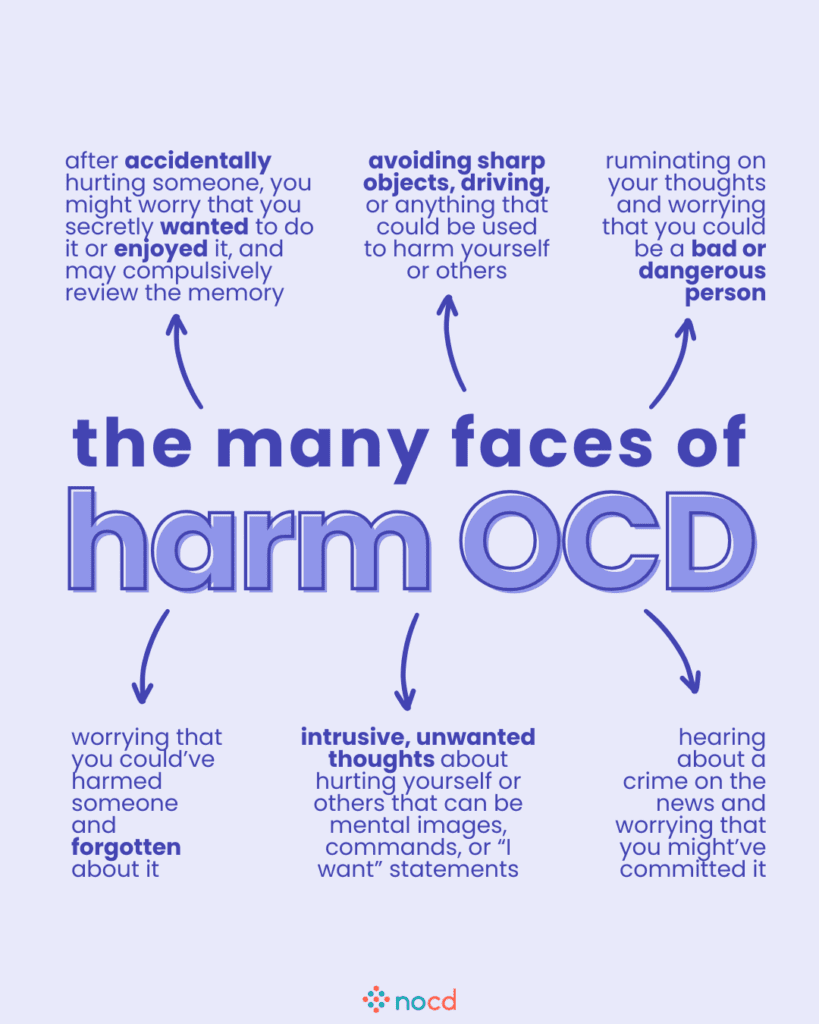
Harm OCD can manifest in many different ways, but the underlying pattern is the same—an intrusive thought triggers intense anxiety, which then drives compulsive behavior to relieve it.
| Obsession | Compulsion |
| Thoughts or images of stabbing, hitting, or killing someone | Praying, counting, or repeating phrases to “cancel” the thought |
| Fear you might swerve your car into traffic or pedestrians | Avoiding driving or refusing to travel certain routes |
| Worry that you’ve already harmed someone and forgotten | Mentally reviewing past actions for proof nothing happened |
| Unwanted images of causing harm to a loved one | Seeking reassurance from others (“I’d never do that, right?”) |
| Intrusive thoughts about self-harm despite not wanting to die | Checking your own feelings repeatedly for signs of genuine intent |
How is harm OCD treated?
The most effective treatment for OCD is exposure and response prevention (ERP) therapy. ERP is a specialized form of cognitive behavioral therapy (CBT) proven to be effective for OCD. General CBT, if not tailored for OCD, can sometimes be unhelpful or even worsen symptoms.
ERP helps you gradually face distressing thoughts and situations without performing compulsions to relieve the anxiety. For someone with Harm OCD, that might look like:
- Holding a kitchen knife while cooking.
- Writing or saying feared phrases aloud (“I might hurt someone”).
- Watching mildly violent TV scenes without reassurance.
- Holding your baby or spending time with loved ones without avoiding the situation.
Over time, the brain learns that the thought isn’t dangerous and doesn’t require a response. Among NOCD members whose primary presentation involved responsibility for harm, 79% showed measurable improvement with ERP therapy.
ERP is sometimes combined with other approaches, including:
- Medication, particularly selective serotonin reuptake inhibitors (SSRIs)
- Mindfulness-based strategies
- Acceptance and commitment therapy (ACT)
Severe or treatment-resistant OCD may sometimes require higher levels of care, such as intensive outpatient programs (IOPs), partial hospitalization programs (PHPs), residential treatment, or other specialized interventions like transcranial magnetic stimulation (TMS).

Find the right OCD therapist for you
All our therapists are licensed and trained in exposure and response prevention therapy (ERP), the gold standard treatment for OCD.
Bottom line
Harm OCD can make you feel like your own mind is a threat—like the thoughts you’re most horrified by say something true about who you are. They don’t.
These thoughts are distressing precisely because they conflict with your values. That’s not a sign of danger — it’s a sign of OCD. And with the right treatment, it gets better.
If what you’ve read here sounds familiar, you don’t have to keep managing this alone. Treatment is available.