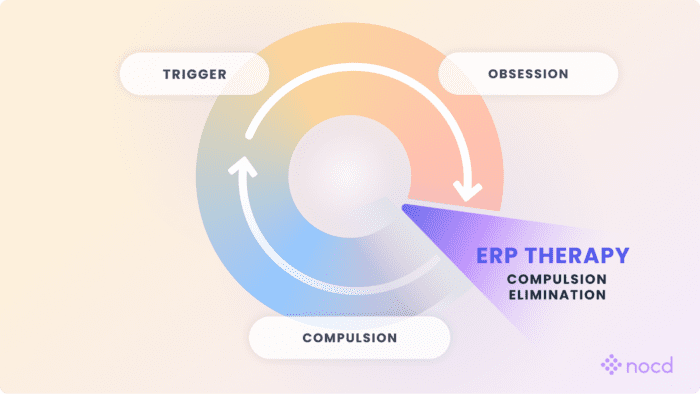
Ask someone to explain exposure and response prevention (ERP)—the gold standard treatment for obsessive-compulsive disorder (OCD)—and they’ll often describe something that sounds highly structured. You identify your fears, rank them from easier to harder, and gradually face them without relying on compulsions.
But structured doesn’t mean scripted. The same framework can look very different from one person to the next.
Below, five NOCD specialists share what goes into turning that framework into an individualized treatment plan—and how two people with what looks like the same problem wind up with totally unique exposures.
What every OCD treatment plan has in common
Before looking at what makes NOCD treatment personalized, it helps to understand what stays the same.
“Every plan shares a basic structure,” explains Dr. Patrick McGrath, Chief Clinical Officer at NOCD. “Goals, exposures designed to move you toward those goals, and response prevention—the practice of resisting the compulsions you normally use when OCD shows up.”
NOCD treatments are built around SMART goals: Specific, Measurable, Achievable, Relevant, and Time-bound. You identify something you want to be able to do, then work toward it through manageable steps.
Exposures are built progressively. Dr. McGrath puts it as a question: “If you’re afraid of elevators, would you want to be thrown into one, or would you want a ten-step process?”
But how different can two treatment plans be?
Quite different, it turns out.
For one NOCD Member whose OCD had kept them from driving, getting back behind the wheel started with something simple.
“We put a pool noodle across the driveway and had them practice driving over it,” Dr. McGrath recalls. “They knew the object was harmless, but they still felt that bump and experienced the doubt that followed. It gave them a chance to sit with that uncertainty without going back to check.”
From there, they worked up to driving around the block. Then came the harder part: getting out of the car and resisting the urge to drive the route again to make sure they hadn’t hit something—or someone.
And it worked. Through progressively harder exposures—and repeated practice resisting the urge to check—the Member was able to start driving again.
So, after hearing this story, you might assume another therapist, faced with a different Member who’s afraid of driving, might tell their Member to reach for the pool noodles.
But that’s not what NOCD Therapist Sonya Keith, LCSW, did.
“You can’t just say, ‘Oh, driving scares you? Let’s go look at a car,’” she says. “That won’t work.”
Sonya was also working with someone whose OCD had kept her from driving—in this case, for 19 years. But her exposures looked nothing like Dr. McGrath’s. There were no pool noodles or practice laps around the block. These exposures involved the Member staging photos of herself appearing passed out or incapacitated in the kinds of situations where paramedics might find her if she had an accident.
It sounds almost unrelated to the treatment plan Dr. McGrath described. Yet this Member eventually started driving again, too. Today, she drives to work and takes her kids to school.
Two people who had stopped driving. Two therapists using ERP. Two treatment plans that looked nothing alike—and both helped their Members regain the freedom and independence OCD had taken from them.
How can two successful treatment plans look so different?
Because what looked like the same problem—being unable to drive—wasn’t rooted in the same obsessions or fears.
Dr. McGrath’s Member was dealing with Hit-and-Run OCD, a pattern of fears about accidentally hitting someone while driving without realizing it. Driving over the pool noodle recreated a sensation that could trigger that fear. Driving around the block gave the Member a chance to experience the doubt that they might have hit someone without realizing it.
That wouldn’t have targeted what was keeping Sonya’s Member out of the driver’s seat. She wasn’t afraid she had hit someone. She was afraid something would happen to her behind the wheel—and how she might be found afterward. So her exposures focused on being seen incapacitated, rather than on whether she had hit something in the road.
In other words, neither therapist was treating “fear of driving.” They were treating the specific fears OCD had latched onto for each person.

Find the right OCD therapist for you
All our therapists are licensed and trained in exposure and response prevention therapy (ERP), the gold standard treatment for OCD.
How does your therapist decide where to start?
What’s driving the OCD?
When Carrie Wells, MS, LPC, first started doing ERP, she bought books full of sample exposures, expecting them to become useful tools in her work. In practice, she found that a handbook can only take you so far. The harder—and more important—part is figuring out what the person in front of you actually needs.
Now, when Carrie hears about a Member’s anxieties, fears, and compulsions, she looks for the pattern.
“A person can come in with a bunch of fears that seem unrelated on the surface,” she says. “I want to know whether the same underlying fear is showing up in different ways. I’d rather understand what’s driving everything than chase each fear one at a time.”
She also looks at what happens after the fear shows up: Does the Member research? Ask for reassurance? Replay what happened? Avoid the situation altogether?
“That tells me a lot more about what we need to work on,” she explains. “It’s not just about what you’re afraid of. It’s about what OCD gets you to do in response.”
What brought you to treatment?
Kim Glassner, LPC, starts with what prompted the Member to seek treatment.
“I go back to why the Member first called us,” she says. “What was it that prompted you to make the call?”
That gives her something concrete to build toward. The goal isn’t simply to find increasingly difficult ways to confront a fear—it’s to help the Member do the thing OCD has gotten in the way of.
“When I design exposures, I try to put in a component of what the person really wants.”
If contamination fears are keeping a parent from taking their kids to a theme park, for example, Kim can build exposures toward actually taking that trip.
She recalls one Member who wanted to read to his child’s class but typically relied on compulsions when he felt anxious. Kim built the exercise around that goal: the exposure was reading to the class while allowing the anxiety to be there, and the response prevention was resisting the compulsions he usually relied on to get through it.
What matters to you?
Alessandra Rizzotti, LCSW, starts with a different question: What matters to you outside of OCD?
“When I first start with a treatment plan, I focus on values and things the person cares about,” she says. “From there, I ask how OCD is getting in the way.”
It’s essential for your therapist to understand those values, because those values set the boundaries of your treatment plan. ERP should not push you to violate your beliefs, morals, or personal boundaries.
We want to understand what matters to you, then design exposures that challenge OCD without asking you to compromise yourself.
Dr. Patrick McGrath, Chief Clinical Officer at NOCD
For someone who values creativity, OCD might turn making art into an exhausting exercise in getting everything exactly right—fixing, redoing, or abandoning work that feels imperfect. Alessandra might build an exposure around intentionally making an imperfect piece of art, then resisting the urge to correct it. That gives the Member practice creating on their own terms rather than letting OCD dictate how the work has to turn out.
A good treatment plan leaves room to adapt
Even a well-designed treatment plan needs room to change as therapy unfolds.
“You can plan to reduce a handwashing compulsion gradually—maybe from washing three times, to twice, to once—but it doesn’t always work like that,” Alessandra says. “Sometimes people backslide, and you have to go back through the hierarchy or try something different.”
Other needs can shape how ERP is delivered, too. If a Member has a sensory sensitivity, Alessandra might modify an exposure—using noise-reducing headphones, for example—so the exercise is challenging OCD rather than the sensory issue itself. If a physical health condition affects what they can safely do, the plan may need to account for those limits or incorporate guidance from a doctor or physical therapist.
Bottom line
Every NOCD treatment plan starts with the same evidence-based framework. But that doesn’t mean your treatment will look like anyone else’s.
Two people can come to treatment with the same problem and still need very different approaches. OCD may be latching onto different fears, leading to different compulsions, or interfering with their lives in different ways.
The point is to target the patterns that are actually affecting your life so you can get back to the things OCD has made harder—your relationships, your interests, your goals, and the everyday things you want to be able to do.