

Lindsay Clancy had thoughts about harming her children. When those thoughts scared her, she told the people close to her and sought help.
Then, in January 2023, she killed all three of her children. And the media coverage hasn’t let up.
If you’ve ever had an unwanted thought about harming your child that scared you, Lindsay’s experience can raise a frightening question:
“Could I do what she did?”
Could I be dangerous?
I could point to the facts. I could tell you that studies show about half of postpartum women report unwanted intrusive thoughts about intentionally harming their infant. I could point out that nearly 3.7 million births happened in the United States in 2022—the year Lindsay gave birth to her youngest child—and of those birthing parents, only one became Lindsay Clancy. I could remind you of the fact that the only reason you know Lindsay Clancy’s name is because her situation is rare.
But if you’re here, stressing about the parallels between yourself and Lindsay, you probably already know her situation is rare. And that hasn’t stopped you from worrying.
Why?
Why am I so worried about this?
You’re a new parent responsible for a life that’s totally dependent on you. You’d do anything for your baby. You’re probably overworked, stressed, and exhausted. And you’ve made mistakes in your life. Said or done the wrong thing. Sometimes by accident, sometimes deliberately.
It’s always turned out okay before. But before, you were only responsible for yourself.
The stakes are higher now.
So you wonder: “What if I do something that hurts my baby?”
“What if I lose control and kill my baby?”
“What if I lose touch with reality and don’t realize it’s happening?”
Maybe you find ways to try to make those thoughts feel more manageable. You might hide dangerous objects, repeatedly check on the baby during naptime, or ask a loved one to promise you that you’re okay. That you’re safe.
You might even compulsively follow the Lindsay Clancy trial—or relentlessly comb the internet for articles that can reassure you that you’re not like Lindsay Clancy.
Maybe your coping strategies aren’t always ideal. Sometimes, they may even get in the way of your day-to-day life. But they seem to help control the fear, at least temporarily.
Then Lindsay Clancy comes along, does the thing you’re most afraid of, and spends weeks atop the news cycle.
Of course that’s going to rattle you.
But why can’t you move on?
Why can’t I move on?
Because the techniques you’re using to try to manage your anxiety are exactly the things that are strengthening its control over you.
Hiding dangerous objects, checking on your baby, asking someone to reassure you—these things make you feel safer in the short-term.
But then you have to go back into the kitchen. Where the knives are.
You put your baby down for a nap. But you haven’t heard a sound on the monitor for forty-five—no, wait, forty-seven—minutes.
And you just had a horrifying, unwanted thought about drowning your baby. And you know you’d never actually want to do that, but you need to hear it from someone else.
So you hide the knives. Check on the baby. Stop giving your child baths. Ask for reassurance.
Because it worked last time.
And that means you need it this time.
And it works. You feel relief. Until you don’t.
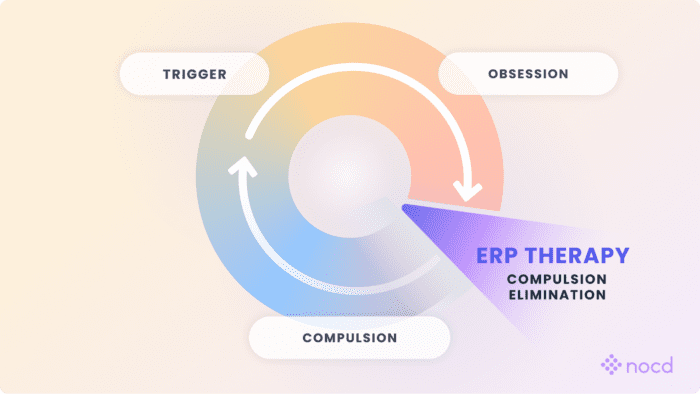
If this sounds familiar, you may be caught in the OCD cycle. An intrusive thought or fear causes anxiety, so you do something to try to make that anxiety go away. That behavior is called a compulsion.
And because the compulsion brings relief, your brain learns to rely on it. The next time the fear shows up, you feel like you need to check, avoid, research, or ask for reassurance all over again.
Does Lindsay Clancy have OCD?
Lindsay Clancy’s defense team has argued that she had bipolar disorder and that she experienced hallucinations and delusions that led her to believe she had to harm her children.
But neither the defense nor prosecution has argued that Lindsay Clancy has obsessive-compulsive disorder (OCD). As far as we know, Lindsay has never been diagnosed with OCD.
OCD had nothing to do with what Lindsay Clancy did.
So how did OCD enter the conversation?
Because parts of Lindsay’s story are familiar to parents with Postpartum OCD. Unwanted thoughts about harming your child. Fear of what those meant. Hope that someone else can take the fear away.
But witnesses testified that Lindsay reported hearing a man’s voice. It ordered her to kill her children and then herself. It told her she had no choice—that if she didn’t obey, none of them would be safe.
That’s not OCD.
In OCD, intrusive thoughts run against everything you want and everything you believe, which is why they horrify you rather than tempt you—and no matter how loud they get, you know they’re thoughts. In psychosis, that can break down, and a thought can arrive as something true, or as something you have no choice but to act on.
When should I get help?
Why not now?
Intrusive thoughts about harming your child don’t have to take over your life, change the way you care for your baby, or pull you into tedious or repetitive coping strategies.
Talk to an OCD specialist.
And when you do, tell them about your thoughts and the things you’re doing to manage them. Ask them whether OCD could be part of what’s going on. A provider can screen you for OCD and help you figure out what kind of care and support you might need. And if what you’re experiencing goes beyond intrusive thoughts—if you’re hallucinating, losing touch with reality, or think you may actually harm yourself or your baby—that’s a medical emergency. Not a moral failing, and not a sign of what you’ll do next. Seek medical care right away by dialing 9-1-1 or going to your nearest emergency room—but know that most people who experience psychotic symptoms never harm anyone.
For pregnancy or postpartum mental health support that is not an immediate emergency, you can also contact the National Maternal Mental Health Hotline, which offers free, confidential support 24/7, or the Postpartum Support International HelpLine for support and connections to perinatal mental health resources.

Find the right OCD therapist for you
All our therapists are licensed and trained in exposure and response prevention therapy (ERP), the gold standard treatment for OCD.
What if they take my baby away?
It can be terrifying to admit to someone that you’ve had thoughts about harming your baby. What if they see me as a threat? What if they take my baby away?
And it’s important to acknowledge that not every parent experiences the healthcare and child welfare systems in the same way. Black families, in particular, face documented disparities in child welfare investigations and are more likely to experience foster care placement. But at NOCD, we don’t make assumptions about a parent’s risk based on their race or background. Our therapists specialize in OCD, and they’ve heard these kinds of thoughts many times before—from parents who love their children and would never intentionally harm them.
And remember: you have a right to privacy when you seek help. The Health Insurance Portability and Accountability Act (HIPAA) protects your health information, including what you tell a doctor or therapist about your mental health.
What about Lindsay Clancy’s medications?
Lindsay was prescribed 13 different psychiatric medications over about four months, and her defense has argued that the way those medications were prescribed and adjusted made her condition worse. At the time of this writing, however, we don’t know what role, if any, medication played in what happened.
Her case does underscore the importance of careful, coordinated treatment. Exposure and response prevention (ERP) is the gold-standard treatment for OCD, and medications—particularly SSRIs—can reduce symptoms alongside it.
Whatever treatment you use, be honest with every provider involved in your care about what you’re taking, what has changed, and how you’re feeling.
Bottom line
Having an intrusive thought about harming your baby does not mean you want to do it—or that you’re destined to become the next Lindsay Clancy.
If these thoughts are taking over your life, help is available. For people whose fears resemble the OCD cycle, ERP can help you stop treating every intrusive thought like a warning—and take on parenthood with the presence and joy that you deserve to feel.