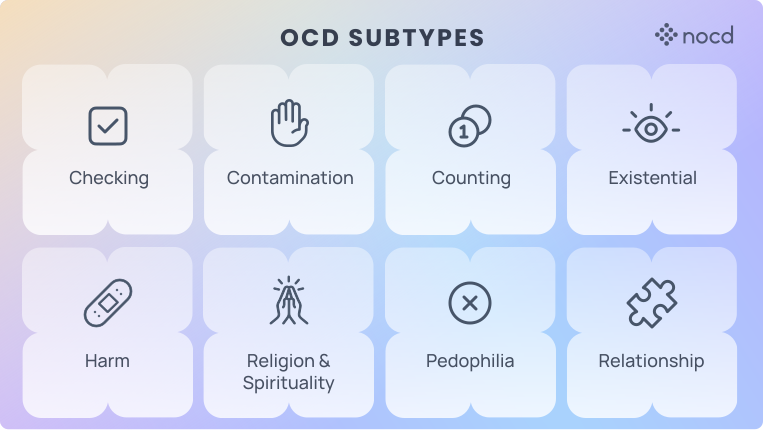


For decades, the term “OCD” has been thrown around as an adjective for liking things organized, which grossly misrepresents the reality of living with the condition and causes widespread harm. Due to these stereotypes and misconceptions, actual obsessive-compulsive disorder (OCD)—which is characterized by distressing intrusive thoughts, time-consuming and exhausting compulsions that can feel impossible to resist, and seemingly constant anxiety—has been dramatically undercounted by the very research meant to measure its prevalence. A new study is finally closing that gap, and the real numbers are striking.
Previous research estimated that OCD affects approximately 2.3% of people in the U.S. But a recent analysis of cross-national data from the World Health Organization’s (WHO) World Mental Health (WMH) Surveys reveals something very different: Millions more people are living with OCD than previously reported.
We’re breaking down why earlier research underestimated the prevalence of OCD, what these new findings mean for the OCD community, and how they connect to our work at NOCD to expand access to effective, affordable, and convenient OCD treatment.
How many people actually have OCD?
For nearly 40 years, the go-to prevalence statistic was that about 2.3% of people in the U.S. would experience OCD in their lifetime. That figure came from the Epidemiological Catchment Area (ECA) survey conducted in the USA in the 1980s. The ECA survey used the Diagnostic Interview Schedule (DIS) to assess for OCD based on criteria in the Diagnostic and Statistical Manual of Mental Disorders (DSM) III. Decades later, in 2010, the National Comorbidity Survey Replication (NCS-R) in the USA also found a lifetime prevalence of 2.3% for DSM-IV OCD.
In 2025, data from the WMH surveys, published in BMC Medicine and drawing on interviews with over 26,000 adults from ten countries across six continents, put the lifetime prevalence of OCD at 4.1%. That’s nearly double the previous estimate—and it means that the real global number of people living with OCD is in the tens of millions more than previously assumed.
The study’s authors are careful to note that, since some of the surveys were regional rather than nationally representative, the results can’t be taken as a precise census of the entire world. But the consistent pattern across such a diverse set of countries is a strong signal that OCD has been undercounted for decades, and that the true number of people living with it is significantly higher than the 2.3% figure most research and reporting has relied on.
Why is prevalence higher than previously thought?
A few things were working against the accuracy of earlier research on the prevalence of OCD. For one, the aforementioned studies focused exclusively on the U.S. This left huge gaps in the global picture, as the U.S. is a higher-income country, and the large majority of the world’s population resides in low- and middle-income countries.
In earlier research, the interview tools themselves were also less precise at capturing the full range of DSM criteria for OCD. The WMH surveys used an updated interview that was more closely aligned with DSM-IV criteria, leading to a larger, more methodologically rigorous sample than any prior study. They also captured data across a much broader and more diverse set of countries, covering Argentina, Australia, China, Colombia, Iraq, Poland, Portugal, Romania, Saudi Arabia, and Spain.
This expanded, more accurate dataset also makes it possible to see how often OCD overlaps with other behavioral and mental health conditions—an additional factor that can complicate diagnosis and delay treatment. About half of the WMH survey respondents also dealt with another behavioral or mental health condition at some point, most often major depressive disorder (22.7%) or social anxiety (14.6%). Since symptoms of one condition can mask or mimic symptoms of OCD, this overlap is often what leads to a missed or delayed diagnosis in the first place.
There’s also a more personal factor at play in this data discrepancy: stigma. Fears of being judged or misunderstood can keep many people with OCD quiet about their symptoms. Due to misconceptions, many people living with OCD are unaware that their symptoms are signs of a diagnosable, treatable condition—so they never end up asking a healthcare provider for help, let alone filling out a research survey. The study explicitly calls out this factor as a likely driver of the historical undercount.
Why understanding OCD’s true prevalence matters
Accurate prevalence data can shape how much attention OCD gets at every level: how well the public understands the condition, how much funding goes toward research, how many resources health systems allocate to diagnosis and treatment, how insurance plans decide what to cover, and ultimately, how easily someone can access effective treatment. On the other hand, undercounting OCD can make treatment harder to find and harder to access for millions of people who need it.
The longer OCD goes unrecognized at a systemic level, the more likely it is to worsen at an individual level. Untreated OCD can create the conditions for mood disorders, anxiety disorders, and substance use disorder to take hold—not as separate, unrelated issues, but as responses to the difficulty of experiencing untreated obsessions and compulsions day after day. And when those secondary conditions are treated on their own, without anyone recognizing the underlying OCD, people can end up in a cycle of partial treatment that never quite resolves what’s going on. Early identification and effective treatment for OCD can help prevent prolonged, unnecessary suffering.
What else this research reveals about OCD
Beyond showing that OCD is significantly more common than once believed, this new research also helps paint a fuller picture of what living with OCD actually looks like around the world, providing valuable insights into the condition’s varying severity, the most common age of onset, and treatment rates. Here are a few key learnings:
OCD exists on a spectrum, and symptoms are more common than diagnoses alone suggest
The study found that 13.6% of people reported some lifetime experience of obsessions or compulsions. This includes both the 4.1% who met full diagnostic criteria for OCD and another 9.5% whose symptoms fell short of a diagnosis. This suggests that OCD likely exists on a continuum, and subclinical cases actually outnumber diagnosed ones.
Among those who did meet diagnostic criteria for OCD, symptom severity varied, as measured by the Yale-Brown Obsessive-Compulsive Scale (Y-BOCS), the clinical standard for measuring OCD severity.
Importantly, OCD, at all levels, can significantly affect daily functioning.
Survey responses also indicated that individuals with more severe OCD are more likely to receive treatment, with treatment rates being highest among severe cases (52.5%). That means the vast majority of people with OCD are the least likely to be treated, even though their symptoms can still meaningfully disrupt their lives.
Early onset is common, and often followed by years of suffering
Survey responses also indicate that OCD tends to start young. Half of all cases included in the WMH surveys began by age 17, and more than 80% began by early adulthood (age 24). These figures represent many people who spend years, sometimes decades, living with symptoms before anyone recognizes what’s happening.
Additionally, OCD is a chronic condition, which tends not to resolve on its own. The WMH surveys found that nearly three-quarters of people who ever had OCD in their lifetime still met criteria for it in the past year, emphasizing the importance of ongoing management and support in addition to early identification and proper treatment.
Even with a diagnosis, access to effective treatment remains scarce
Given OCD’s chronic nature, access to proper care is essential. Yet according to the study, effective, evidence-based treatment is still hard to come by for most people with OCD. Only about 19.8% of survey respondents with OCD received any mental health treatment in the past year—and that figure includes any kind of care, not evidence-based treatment designed specifically for OCD, like exposure and response prevention (ERP) therapy.
The gap is even starker depending on where in the world someone lives, with 40.5% of individuals with OCD receiving mental health treatment in high-income countries compared to only 7.0% in lower-income countries. But the underlying message applies everywhere: specialized, effective OCD care is still the exception, not the rule. Being overlooked and untreated is a systemic, worldwide pattern.
At NOCD, we’ve been meeting this need before the numbers proved it
These statistics, while sobering, aren’t news to us at NOCD. We’ve always viewed OCD as a widespread, often-overlooked condition, and we built NOCD because we saw this gap long before this study put numbers behind it.
NOCD exists to address exactly what the study highlights:
OCD is often overlooked or misdiagnosed: Our world-class therapist training program works to close previous gaps in clinical education.
The NOCD Clinical Leadership Team, a group of world-renowned clinicians and researchers who have dedicated their careers to treating OCD, has developed a world-class therapist training program focused on properly diagnosing and effectively treating all forms of OCD using evidence-based treatment—not just the most visible or widely-known presentations. During their extensive specialized training, NOCD Therapists are educated in the full range of ways OCD can present, from harm-related intrusive thoughts, to religious scrupulosity to relationship-focused doubts and fears.
Training doesn’t stop once a therapist joins NOCD’s network. Our therapists continue to receive ongoing education and consultation to stay current with the latest research in OCD treatment. This helps close clinical education gaps, ensuring that our Therapy Members are always working with a therapist whose skills reflect the most up-to-date, evidence-based approaches, setting them up for the best possible outcomes.
OCD is undertreated: We match people with therapists trained in ERP and educate providers on the condition.
ERP therapy is the most effective treatment for OCD, but for a long time, it was incredibly difficult to find a therapist with the necessary training to deliver it. In response to this urgent need, NOCD has built the largest network of OCD-specialty therapists, all of whom have completed our rigorous training program.
We also partner directly with healthcare providers, offering education and resources so that primary care doctors, pediatricians, and other clinicians can better recognize OCD and refer people to specialized care sooner. Our therapists collaborate closely with referring providers to ensure that our Members’ care is seamless.
OCD is a chronic condition: We provide treatment for children, adolescents, and adults, and support that goes beyond the therapy session.
NOCD Therapy includes support between sessions, because we know that those are often the moments when it matters most. Our Therapy Members can directly message their therapists between sessions and get a response within 24 hours, join dozens of virtual support groups, use expert-developed therapy tools, and engage with an active community of others navigating OCD, all in the NOCD app (available on iOS and Android)—so they’re never managing OCD on their own.
Specialized treatment for OCD has historically been difficult to access: We’ve broken down geographical and financial barriers.
For many people, the nearest OCD specialist is hours away—or doesn’t exist at all in their region. NOCD’s virtual treatment model allows Members to access high-quality OCD treatment globally from anywhere, no matter where they live. NOCD’s platform serves Members in all 50 U.S. states, the U.K., Australia, several Canadian provinces, and many other countries.
Our model also has the advantage of allowing people to learn to confront fears in their daily environments, where triggers often occur. Peer-reviewed research has shown virtual ERP therapy with NOCD to deliver significant improvements for adults in less than half the time of traditional in-person ERP therapy, reducing symptoms of OCD, anxiety, and depression, while improving quality of life scores. A separate study found similar results for children and adolescents, with a nearly 40% reduction of OCD symptoms after 13 therapy sessions on average, demonstrating how quickly NOCD Therapy works.
Insurance coverage—another major factor in accessibility—was almost non-existent for OCD-specialty therapy up to as recently as a few years ago. NOCD’s dedication to partnering with providers has made it possible for over 138 million Americans with commercial insurance plans to access this life-changing treatment through their health plan benefits. We accept many major insurance plans, including Aetna, Cigna, UnitedHealthcare, many Blue Cross Blue Shield plans, and more.
Looking ahead: What this data means for the OCD community
Many people with OCD spend years feeling alone in what they’re going through, when in reality, they’re part of a much larger group that has simply gone unrecognized. This research helps validate that truth for millions of people, and affirms the crucial work of advocates raising awareness of OCD and effective treatment. It also reinforces something that our team at NOCD has believed from the start: OCD needs to be identified as early as possible, and evidence-based treatment needs to be accessible to everyone who needs it.
Higher prevalence means we’re finally seeing the true picture. More accurate data can open the door to better recognition, more research funding, and more specialty providers entering the field, increasing access to treatment that can help people regain their lives. The more visible OCD becomes in data, the harder it is to wave it off as a punchline or a rarity—and the more people can finally get the help they need.
This research also strengthens the case for our ongoing work at NOCD: increasing access to evidence-based treatment by matching people with licensed therapists who deeply understand OCD and specialize in ERP, making treatment convenient, providing insurance coverage, and building support into every part of the treatment journey, including the time between therapy sessions, when it’s often needed the most.
Whether you’re newly diagnosed or you’ve lived with OCD for decades, you are not alone. You’re part of a resilient, worldwide community that’s much larger than the previous numbers suggested. And OCD, at any severity level, can be treated with the right kind of care.
To learn more about getting started with the most effective treatment for OCD, schedule a free 15-minute call with our team today.