


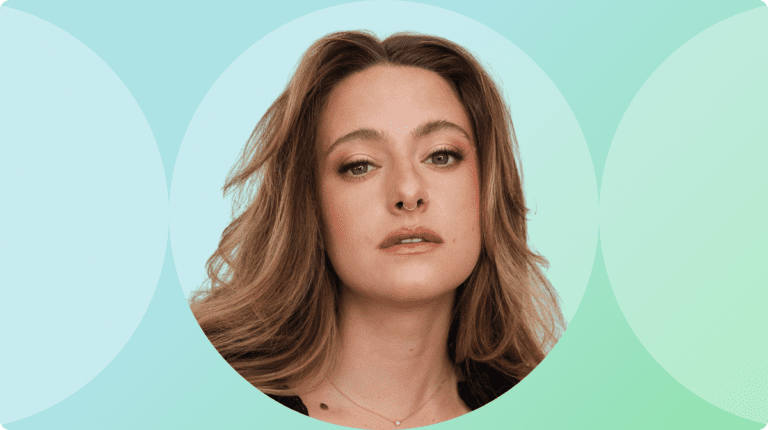
Author Haley Jakobson used to believe her intuition was guiding her choices. Every “gut feeling” felt like a command to take action. Every fear seemed like a signal from a higher power. In reality, however, the urgent, unrelenting voice controlling Haley’s life was OCD—and learning to recognize it for what it really was changed everything.
In this talk, Haley shares how her OCD disguised itself as intuition, how she learned to listen to her values instead of OCD, and how specialized therapy helped her reclaim her life, without having to let go of her spirituality. She also answers questions from the NOCD Community through the lens of her lived experience, alongside NOCD Therapist Shauna Pichette.
This article is adapted from a live NOCD event with Haley.
“How my OCD disguised itself as my intuition”
I experienced scrupulosity OCD through what started out as a hobby of yoga. I started doing yoga my junior and senior years of college, and at first, it was a healthy outlet. But the more I started to get into the teachings of yoga and spirituality, the more my brain started to latch onto these things and make a lot of meaning out of the “right” and “wrong” way to live a spiritual life.
At the time, I felt like I wasn’t on the most spiritual path. And because of all of this outside noise around different spiritual practices, I didn’t really know what to do with that information.
There was a lot of talk about the universe, a lot of talk about “what is meant for you,” and a lot of focus on meditation, which was always very hard for me and continues to be. What I find so difficult about meditation is that when I close my eyes and try to find stillness, the voice that comes into my head, the voice that I was taught is intuition, is actually my OCD.
What I find so difficult about meditation is that when I close my eyes and try to find stillness, the voice that comes into my head, the voice that I was taught is intuition, is actually my OCD.
What I find so difficult about meditation is that when I close my eyes and try to find stillness, the voice that comes into my head, the voice that I was taught is intuition, is actually my OCD.
When I closed my eyes to try to meditate, my “intuition” started speaking to me. All of the things that it said were awful, nasty, deeply upsetting, and full of urgency and panic. And I thought, “Oh my god, I’m having a spiritual awakening.” These thoughts are coming to me from the universe, and even though they are so upsetting, I have to listen to them. This is my path.
At that point yoga, spirituality, and meditation were no longer fun or healthy. They became obsessive.
When spirituality becomes obsessive
During any spiritual practice, my OCD was telling me, “This is for you. This is what you must do. This is what you must follow.” Everything became a sign, an omen, a prophecy. Objects, feelings, smells…my OCD would latch onto all of it. And I told myself over and over again that it was intuitive. I thought the universe was talking directly to me.
But my intuition was never about having a happier, healthier life. It was always trying to punish me and show me all the ways that I was going to fail and suffer.
It wasn’t until I experienced my first really bad bout of relationship OCD (ROCD) that I got into exposure and response prevention (ERP) therapy and started to reflect to my therapist about what happened to me. That’s how I learned about scrupulosity OCD and magical thinking.
Listening to values instead of intuition
My ERP therapist told me it can be hard for people living with OCD to have an intuition, let alone trust one. That was incredibly freeing for me, as someone who had always thought that I should trust my intuition. Instead, I could just let it go and focus on what ERP teaches, which is value-based living.
Value-based living means that, instead of following our thoughts and feelings, we live life according to our values. So, if I really like a shirt and think that it brings out my eyes, even though OCD might try to tell me that I’m going to get hit by a car if I wear that shirt, I’m still going to wear the shirt. Maybe I’ll get hit by a car while wearing it, maybe I won’t, but not wearing it would be giving a lot of power to a shirt, right?
I always say I don’t live a feeling-based life. I live a value-based life because my feelings are not very dependable. I have OCD, I have really big feelings, and I have them all the time. And, at this point, five or six years into ERP therapy, feelings are just a lot less interesting to me than my values, which feel very very grounded and reliable.
At this point, five or six years into ERP therapy, feelings are just a lot less interesting to me than my values, which feel very very grounded and reliable.
Through ERP, I’ve learned to poke at things that feel like signs or gut feelings, take a step back, and ask myself, do I really want to listen to that feeling or can I look at my values instead? Because if a feeling comes with urgency and panic, that’s not my intuition. And at one point it was scary to reject intuition, but now I’ve established new anchors in life.
Q&A with the NOCD Community and NOCD Therapist Shauna Pichette
Haley joined NOCD Therapist Shauna Pichette for an event and answered questions from the NOCD Community based on her lived experience. This Q&A has been edited for length and clarity.
What is the difference between my intuition and my OCD?
Haley Jakobson: If we’re looking at that question through the framework of ERP, you don’t need to know. ERP tells us not to go down into the trenches trying to solve a problem and get the “ultimate answer.” Instead, it’s about that redirection of focusing on your values.
How do you navigate relationship OCD when it comes to figuring out if something is a gut feeling or OCD? It feels impossible to tell.
Haley Jakobson: With relationship OCD, we’re always looking for certainty around whether or not the relationship is right for us, or we’re right for our partner. And there’s so much noise around “when you know, you know,” and having certainty around your relationship, but when you have OCD, what you want to do is stop trying to find the answer.
Instead, you want to figure out what your values are when it comes to being in a relationship and see if, for the most part, you and your partner are able to live by those values. And you can do that alongside uncertainty, disgust, guilt, or any other feelings that might come up. You can live according to your values even if OCD has a lot to say about it.
If we can’t tell the difference between OCD and gut feelings, how do we navigate life?
Haley Jakobson: I think we live in a society where “trust your gut” can become the framework through which we view life. And the thing is, that doesn’t really work for people who have OCD because it can create so much upset and dysregulation for us. What we can do instead is switch to a different framework. I talk about values so much because that’s what works for me.
Shauna Pichette: I often tell my Members, maybe there is no “right” decision. There are lots of right decisions, and lots of good-enough decisions or value-driven decisions. And I think with OCD there is that search for certainty and the idea that something has to either be right or wrong, when really life exists in the gray area.
Haley Jakobson: With OCD, sometimes “right or wrong” can feel life-or-death, but one of the things that I love about ERP is that it aims to take the urgency out of making decisions. The more I have done ERP, the more my values have become clear to me because I’m not always acting out of panic. I actually have the time and space in my mind to zoom out and ask myself questions about what would be fulfilling for me.
How do you determine what your values are?
Shauna Pichette: That clarity comes with practice. With ERP, we’re turning down that urgency. Values are essentially becoming that guiding light that helps you through life. There are lots of different tools that people can find their values—values cards, values tests and inventories, things like that. But I would love to hear from you, Haley, about how you discovered some of your values and what that process was like for you.
Haley Jakobson: I love this values deck by Lisa Congdon. I’ve also been doing ERP for six years, and I often learn my values when I’m being presented with an exposure.
For example, my OCD really latched on to driving. I believed that the universe had said directly to me, “You are not destined to drive.” I thought that I would hurt everyone around me if I did. So when I got into ERP therapy, I told my therapist about this. I had no idea that it was part of my OCD, but I started doing driving lessons as part of my treatment and I’m very happy to say I got my driver’s license at 28. It’s honestly one of the biggest accomplishments of my entire life.
I learned to drive because I asked myself, what would be the value in getting my license? And there are a bunch of values involved:
- If a loved one were to get sick, I would like to be able to drive so I can take them to the doctor or the hospital.
- I want to have a balanced relationship with my partner. Since I really value traveling and going on trips, I would like to be able to split the time with them, so that they don’t become exhausted on long drives.
- I value independence. I want to be able to listen to music while driving by myself, with the windows down and the volume up.
When I have intrusive thoughts, which I still do, I go back to my values, and one of my values is not letting OCD win. If OCD says I can’t do it, I’m going to do it because OCD cannot steal my joy and independence from me.
I struggle because I’ve been correct about a handful of cases of intuition that were tied to my OCD. Since I’ve been proven right, I have a very difficult time letting these things go. What do I do?
Shauna Pichette: A broken clock is right twice a day, so sometimes OCD can seem correct. However, most of the time, an intrusive thought and a particular event aren’t actually connected in reality. So when my Members say, “Shauna, that thing I was so afraid of happened because I didn’t do my compulsion,” what we’ll usually do is test the idea that thoughts can cause things to happen. We might do something like concentrate really hard on making the ceiling fall down on us, and when it doesn’t happen, they’ll see that there’s a disconnect there.
Just because OCD was correct about one outcome doesn’t mean it’s always correct. Life is full of uncertainty and happenstances.
Haley Jakobson: If you’re feeling like the exception to the rule, like you need to keep that sense of urgency, that’s extremely common. OCD is the doubting disorder, so you might doubt whether a thought is intuition or OCD. I still think, “Maybe I’m lying, and it’s not OCD.” But even if I’m wrong, my quality of life is so much better than it was before I got my diagnosis, so I choose this.
And one of the things that ERP gave me was the ability to choose, because I was at the whim of whatever OCD wanted for 27 years of my life. The uncertainty is always going to be there, but you learn over time that the uncertainty is your friend and the search for certainty is your enemy.